National Survey Investigating Hallucinogenic Trends
National Survey Investigating Hallucinogenic Trends
National Survey Investigating Hallucinogenic Trends (NSIHT): The depth to understand psychedelic use. The rigor to understand its population impact.
The National Survey Investigating Hallucinogenic Trends (NSIHT) combines in-depth measurement of real-world psychedelic experiences with rigorous population methods to understand who uses psychedelics, how they are used, their outcomes, and how use is changing across the United States.
Explore Our Data and Publications

What makes NSIHT different?
Deep measurement
Detailed psychedelic, substance-specific measurement of behaviors, motivations, settings, experiences, benefits, risks, and outcomes.
Population-level evidence
Strategic enrichment (increased sample) of people using psychedelics combined with validated data-fusion and transport-weighting methods to generate nationally representative estimates.
Ongoing surveillance
Twice-yearly data collection designed to detect changes in psychedelic use, emerging behaviors, markets, and policies.
Explore our data and view our most recent reports here: NSIHT Data and Reports.
Designed to understand the whole picture of psychedelic use
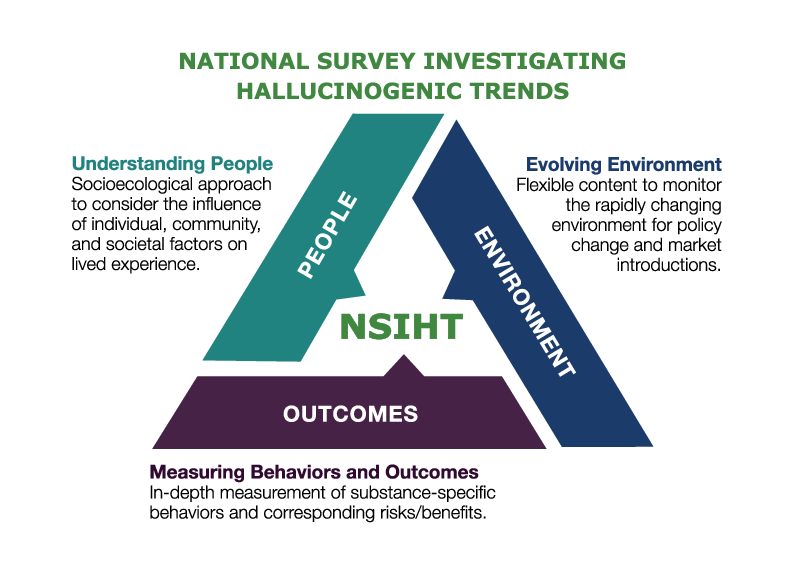
We designed a custom surveillance system for psychedelics from the ground up with a focus on understanding people, measuring behaviors and outcomes, and studying the evolving environment.
NSIHT is intentionally designed as a flexible surveillance system capable of responding to policy changes, new products, terminology, and emerging behaviors.
Built for rigorous population science
- 10,000+ adults reporting recent psychedelic use surveyed annually since 2024
- 17 psychedelic, hallucinogenic, or dissociative substances captured - measured individually, including pharmaceutical and nonmedical forms
- 2× per year repeated nation-wide data collection
- 50 states and Washington, DC with substance-specific state estimations
- Strong test-retest reliability of past year use of psychedelics across all 17 psychedelic substances
- Externally validated transport-weighting methodology benchmarked against federal population surveys
How NSIHT works
NSIHT uses a sampling enrichment method to enhance data collection on adults who have used a psychedelic substance in the last 12 months.
Because psychedelic use is uncommon in the general population, NSIHT recruits enough people with recent experiences to study those behaviors in detail, then uses validated statistical methods to support population-level inference.
We accomplish this by taking the psychedelic-enriched sample and applying an externally validated transport-weighting and data-fusion approach to combine that data with a large general-population survey.
See our full methodology description here: NSIHT Data and Reports.
Who Uses Our Data
Researchers • Government Agencies • Clinicians • Policymakers • Drug Developers
Work With Us
We offer technical reports, limited datasets, and expert consultation. We also allow for sponsored content, where external researchers can answer their own questions through our tool.
Data subscriptions for regulatory or surveillance purposes are also available.
Reach out to info@rmpds.org for more information.
Funding
Data collection and investigators are supported by the National Institute on Drug Abuse (NIDA) of the National Institutes of Health (NIH) under Award No. R01DA064612.
Data reports and topical expertise are conducted in collaboration with the Substance Abuse and Mental Health Services Administration (SAMHSA), as well as previous methodological development validation under annual grants #75S20124P00003, #75S20123P00004, and #HHSS283201700 075I/75S20321F42002.
NSIHT is owned and operated by Denver Health’s Rocky Mountain Poison and Drug Safety (RMPDS).
The views expressed on this website are those of RMPDS and not NIH, NIDA, nor SAMHSA.
FAQ
1. What is NSIHT?
The National Survey Investigating Hallucinogenic Trends (NSIHT) is an ongoing national surveillance study designed specifically to understand psychedelic use in the United States.
2. Why was NSIHT created?
NSIHT was created to address a specific goal. Traditional general-population surveys can measure psychedelic prevalence, but relatively low prevalence makes it difficult to study psychedelic specific substances, behaviors, contexts, benefits, risks, and emerging trends in depth. NSIHT complements existing national and international surveys by focusing on detailed, real-world psychedelic use while using statistical methods designed to support population-level inference. Its enriched sampling design allows NSIHT to study relatively uncommon substances and behaviors in greater depth than is typically possible in broad general-population surveys.
3. Who participates in NSIHT?
NSIHT collects surveys from adults in the US who have used at least one of seventeen psychedelic, hallucinogenic, or dissociative substances in the 12 months preceding the survey. All surveys are confidential and anonymous and data are protected by a NIH Certificate of Confidentiality. We collect these data through partnerships with commercial panel companies who help ensure we are measuring real people and their real experiences. We prioritize respondent trust and data quality because NSIHT asks about sensitive topics and experiences.
4. Why does NSIHT intentionally recruit more people who use psychedelics?
Use of many psychedelic substances and the corresponding experiences are uncommon in the general population. A conventional sample of thousands of randomly selected adults could contain very few people with experience using a particular substance. Enrichment gives NSIHT sufficient observations to investigate substance-specific behaviors and outcomes, and understand health outcomes associated with psychedelic use.
5. If NSIHT oversamples people who use psychedelics, how can its estimates be nationally representative?
The sample that is reporting psychedelic use alone is combined through statistical calibration and transport weighting techniques to a large population survey which allows estimates to be weighted to approximate the US adult population. This allows NSIHT to provide rich data on psychedelic use while bringing in the epidemiological population perspective. Our methods are outlined in the Data and Reports page for a full description of the weighting approach.
6. How often is NSIHT conducted?
NSIHT collects survey data during two launches per year, in the Summer and Winter. This allows for mid-year and annual trend detection and flexibility to measure the evolving landscape.
7. How does NSIHT make sure people understand and answer the questions reliably?
NSIHT survey content was designed after conducting focus groups and included lived-experience input, expert consultation, comprehension testing, and includes many validated instruments. NSIHT also conducted a test-retest reliability study of use of psychedelics in the last year, reasons for use, and recency of use. These findings can be found in our list of publications and methods documents on the Data and Reports page. NSIHT is committed to the continue validation and testing of the survey instrument.
8. What does “nationally representative” mean for NSIHT?
In NSIHT, nationally representative inference is produced analytically after data fusion and calibration. Estimates are meant to be nationally representative of all adults in the US.
9. Can NSIHT estimate psychedelic use in individual states?
Yes, NSIHT uses small area estimation to produce state-level population prevalence estimates for substance-specific psychedelic use in all 50 states and Washington D.C. These estimates can be accessed for free on the Data and Reports page. Our methods document outlines the two-stage validation approach taken to generate these estimates.
10. What are the limitations of NSIHT data?
NSIHT data are collected through anonymous, confidential surveys but are based on self-report and recall windows of the past 12 months. Given the nature of the sampling through commercial panel companies, there are some populations that NSIHT is not intended to provide inference to: Indigenous use practices, institutionalized adults, or overseas/deployed military personnel as examples. There may be some residual selection bias despite weighting and uncertainty for very uncommon substance-specific behaviors. Finally, the state estimates are based on small area estimation and therefore have some model dependence.

NSIHT Psychedelic Survey Research
National population survey monitoring the real-world use of psychedelics to understand prevalence of use, context of use, benefits, and harms.